
세광(Elutriation) 로터
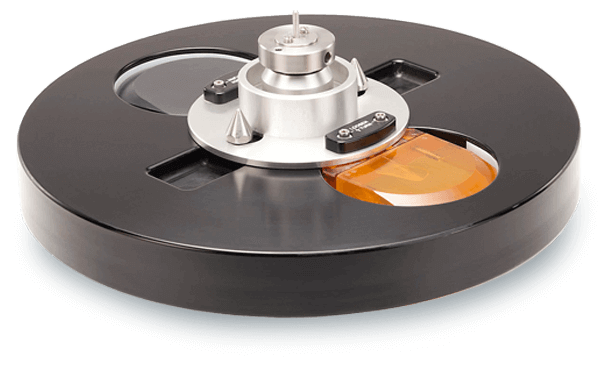
세광 로터(Elutriation Rotor)는 크기에 따라 단일 세포 또는 입자(직경 약 2~50µm)인 단 분산 부유액을 분리 및/또는 농축하기 위해 제작되었습니다. 세광 로터는 두 가지 분리 기술을 결합하고 챔버의 각 세포는 상충되는 두 가지 힘에 따라 이동합니다.
- 원심력: 회전축에서 멀어지게 하는 힘 이는 원심력 영향을 받는 침전 과정입니다.
- 유체 속도: 회전축을 향한 추진력 – “역류 세정” 이 작용은 세척에 의한 분리 과정입니다.
깔때기 모양의 챔버에서 분리 작업이 이루어집니다. 로터가 회전하는 동안, 세포 현탁액은 미리 정해진 유속으로 원심분리기 외부에서 로터로 유입되어 용리 챔버의 좁은 끝부분까지 이동됩니다. 현탁 세포가 챔버로 유입되면서, 침전 속도에 따라 두 힘의 영향이 균형을 이루는 위치로 이동합니다.
침전 속도가 낮은 작은 세포는 회전축 방향으로 빠르게 이동됩니다. 이 세포들은 로터를 통해 챔버 외부 방향으로 향하고 수집되는 공간으로 이동합니다. 중간 크기의 밀도가 높은 세포는 챔버를 통해 더 천천히 이동하여 세광 경계에서 평형에 도달합니다. 가장 크고 밀도가 가장 높은 셀은 원심력과 유체 속도가 높은 챔버의 입구 근처에 남아 있습니다. 더 크거나 조밀한 세포의 연속 조각은 유속을 여러 단계로 점점 높이는 방식으로 수집할 수 있습니다. 유속을 조금씩 계속 높일 경우, 결국 모든 세포를 챔버에서 세광(elutration)하게 됩니다.
FAQ on Elutriation Rotors
How does an elutriation rotor work?
An elutriation rotor contains a specialized chamber in which cells are exposed to opposing centrifugal and fluid-flow forces. Smaller cells are carried out of the chamber more readily, while larger or denser cells remain until flow conditions change. This enables sequential collection of distinct cell populations.
What is counterflow centrifugal elutriation?
Counterflow centrifugal elutriation is a separation method in which fluid is pumped toward the center of a spinning rotor while centrifugal force drives particles outward. The balance between these opposing forces allows cells to be separated according to size and sedimentation behavior.
How are cells separated during centrifugal elutriation?
During centrifugal elutriation, cells are exposed to two opposing forces: centrifugal force, which drives cells away from the axis of rotation, and fluid flow, which pushes them in the opposite direction. Cells separate according to their size and sedimentation behavior. Smaller cells are elutriated first, while larger or denser cells remain in the chamber until higher flow rates are applied.
What is elutriation?
Elutriation is a separation technique that uses opposing fluid flow and centrifugal force to separate particles or cells according to their size and sedimentation properties. Unlike pelleting-based methods, elutriation enables continuous fractionation of cell populations while helping maintain cell viability.
What is centrifugal elutriation?
Centrifugal elutriation is a laboratory technique that combines centrifugation and controlled fluid flow within an elutriation chamber. Cells or particles separate based on their size and sedimentation rate as fluid moves against the centrifugal field.
What applications are elutriation rotors commonly used for?
Elutriation rotors are commonly used for cell fractionation, immune cell isolation, stem cell research, cell enrichment, cell therapy development, and other applications requiring gentle separation of viable cells.
What is the difference between elutriation and conventional centrifugation?
Conventional centrifugation typically separates particles by pelleting them within a tube. Elutriation separates cells continuously using opposing fluid flow and centrifugal force, enabling collection of distinct populations while minimizing cell stress and supporting higher cell viability.
What are the advantages of centrifugal elutriation?
Centrifugal elutriation can support gentle cell processing, high recovery rates, scalable workflows, and reproducible fractionation of cell populations. It is commonly used when viable cells must be isolated without labeling or extensive sample manipulation.
Why is elutriation used for cell separation?
Elutriation enables label-free separation of viable cells based on physical properties such as size and sedimentation rate. This makes it useful for applications where maintaining cell integrity and functionality is important.
