

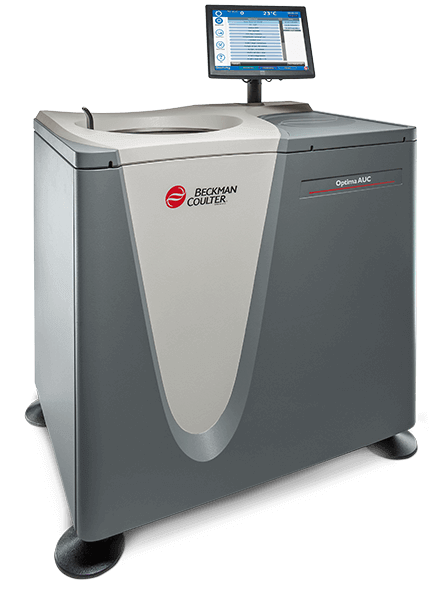
분석형 초고속원심분리기
솔루션 내 고분자 특성화
분석형 초고속원심분리기는 단백질이나 다른 고분자의 분자량, 유체역학적, 열역학적 특성을 확인할 수 있는 가장 다용도적이고 정확한 수단입니다. 현재 동등한 수준의 정밀도와 정확도로 동일한 정보를 제공할 수 있는 다른 기술은 없습니다.
분석형 초고속원심분리기에 대해서 더 알아보고싶다면?
- Resources Section에서 더 자세한 정보를 확인하세요
- On-demand webinars를 통해 AUC에 대한 인사이트를 얻으세요
FAQ on Analytical Ultracentrifuges
What is the difference between analytical and preparative ultracentrifugation?
Preparative ultracentrifugation is primarily used to separate and isolate particles for collection, while analytical ultracentrifugation is used to characterize and measure molecular properties. Analytical systems provide quantitative information about molecular weight, sedimentation behavior, aggregation, and sample heterogeneity.
What is analytical ultracentrifugation?
Analytical ultracentrifugation (AUC) is a solution-based analytical technique that uses high centrifugal forces to study the physical properties of macromolecules and particles. Researchers use AUC to determine molecular weight, size distribution, shape, aggregation state, and molecular interactions without the need for labels or reference standards.
What are the applications of analytical ultracentrifugation?
Analytical ultracentrifugation is widely used in biopharmaceutical development, protein analysis, antibody characterization, viral vector research, nanoparticle studies, and formulation development. It is particularly valuable for studying biomolecules under conditions that closely resemble their native environment.
How does analytical ultracentrifugation work?
Analytical ultracentrifugation works by spinning samples at very high speeds and monitoring how molecules move through a solution. The rate of sedimentation is measured using optical detection systems, allowing researchers to characterize molecular size, shape, concentration, and interaction behavior with high precision.
